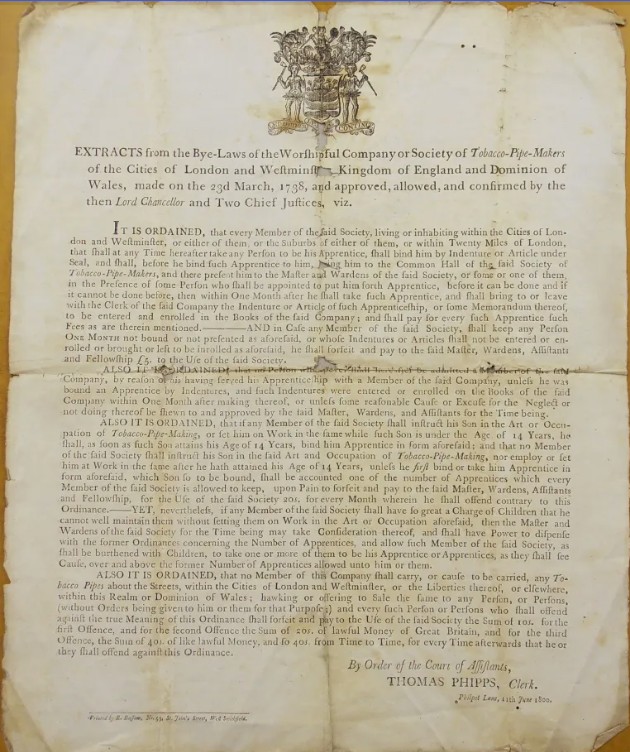
1738 Bye-Laws of the London Company of Tobacco Pipe Makers, printed in 1800
16th November 2026Edited Blog Post by the National Pipe Archive, University of Liverpool, 2016
For many years from 1619, the tobacco pipe-making trade in and around London was controlled by an incorporated Company of tobacco pipe makers. Operating under the jurisdiction of the City of London authorities, it could present its Freemen to the City Chamberlain for admission to the Freedom of the City of London, giving them the right to trade within the City.
Although few records survive, we know that there were three successive Companies of tobacco pipe makers in some form, dating back to the early seventeenth century.
The first was established in 1619, when James I granted a charter of incorporation to the “Master, Wardens and Society of Tobacco Pipe makers of Westmynster”. Its Patent was surrendered in 1621, although the organisation appears to have continued in some form until the mid-1620s.
A second Company was formed in 1634, with a charter covering tobacco pipe makers in the Cities of London and Westminster. This was revoked in 1639, but the organisation seems to have survived until about 1642.
The third Company came into existence in 1663, when Charles II granted a charter to tobacco pipe makers in London and Westminster, and throughout the Kingdom of England and the Dominion of Wales. This organisation regulated the trade in clay tobacco pipes both in and around the capital for the next two centuries, eventually disappearing from the City registers in the 1860s.
A document in the National Pipe Archive's collection at the University of Liverpool provides an intriguing glimpse into how this third Company operated. Entitled Extracts of the Bye-Laws of the Worshipful Company or Society of Tobacco-Pipe-Makers of the Cities of London and Westminster, Kingdom of England and Dominion of Wales, it sets out regulations made on 23 March 1738 and approved by the then Lord Chancellor and Two Chief Justices. The surviving copy was printed in or shortly after 1800 and is signed by one Thomas Phipps, Clerk. Unlike freemen of the trade, Clerks to City of London livery companies at the time were attorneys or solicitors who maintained separate private practices. Phipps does not appear in standard trade directories and would not have been a pipe maker.
These bye-law extracts deal principally with apprenticeships. They limit the number of apprentices a master pipe maker could employ, and required prospective apprentices living within twenty miles of London to be presented to the Master and Wardens of the Company, either before starting work or within a month of being taken on.
Interestingly, the rules also required the children (sons) of pipe makers to be formally apprenticed from the age of fourteen. Apprenticeships normally lasted seven years, after which a young man could establish his own business.
Members were also prohibited from hawking or peddling their pipes in the streets for sale.
These seemingly straightforward regulations reveal much about the working lives of tobacco pipe-making families, the training of successive generations and the restrictions placed on those practising the trade. They offer a fascinating reminder of just how closely commercial life was regulated in the eighteenth century.