The Story of the Orlik Company
8th October 2026Luxury briar pipe makers
The story of L Orlik Ltd began in Vienna, Austria, where the Orlik family had a thriving wholesale butchery business. Alois, known as Louis Orlik, born in 1875, and his younger brother Alfred, born in 1878, had no desire to follow their father into the meat trade. Louis decided instead to try something different and opened a shop in Vienna selling cigarette and cigar holders.
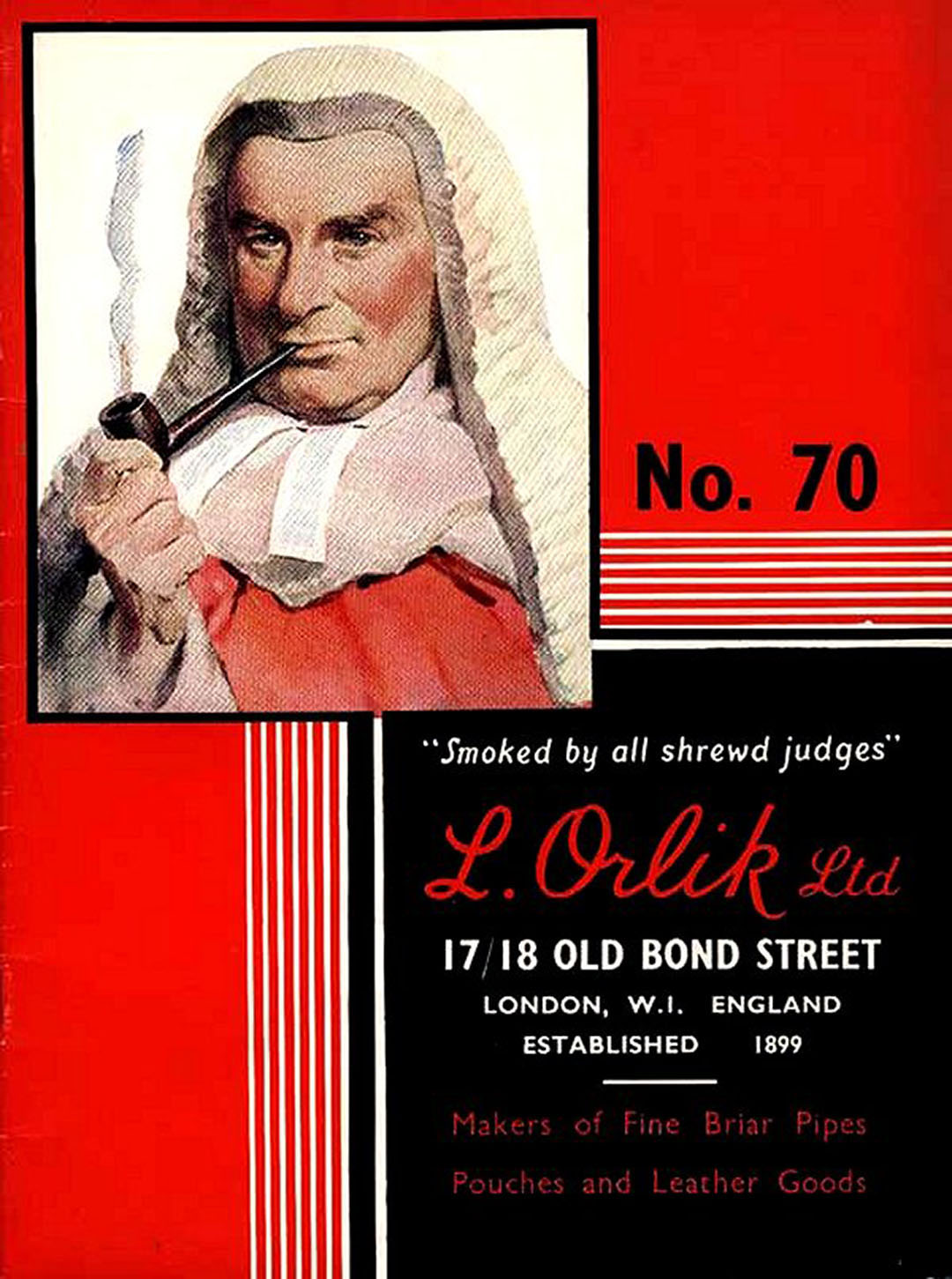
Towards the end of the 1890s, Louis travelled to England and in 1899 he set up his own tobacco pipe-making business in London, initially making meerschaum pipes with amber stems. His newspaper advertisements carried the words “established 1899” for many years afterwards.
In 1904, Alfred joined him in England and the brothers began trading as L & A Orlik. Until around 1919 they imported and sold pipes and smokers’ requisites, with representatives in the USA, Canada and Australia. In 1910, Orlik’s became the first firm in England to manufacture petrol-fuelled lighters.
In August 1909 Louis briefly returned to Vienna to marry Margaretha “Greta” Sobotka and the couple returned to England, where in 1914 Louis was naturalised as a British citizen.
Shortly after the First World War, a rift developed between the brothers. In 1918 Alfred left for the United States, where he was naturalised as a US citizen and established a smokers’ requisites and fancy-goods retail business in his own name, with his first premises in New York on Madison Avenue and later on Fifth Avenue. Louis remained in Britain, developing the Orlik business under the name L. Orlik, while Alfred retained the exclusive distribution rights for Orlik pipes in the United States.
By 1919 Louis had an office and showroom at 62 and 63 Barbican, and established a factory at 26 Great Arthur Street, EC1. In 1923 he travelled to St Claude in France, then the centre of the briar-pipe industry. He persuaded several skilled craftsmen to come to England to work for him, enabling Orlik to begin manufacturing its own briar pipes. When Louis died in 1956, newspapers rather expansively reported that he had “imported a whole pipe-bowl factory from Corsica”.
In 1926 Louis moved the factory to new premises at 43a Ashbrook Road, N19. As well as pipes, the company began making pipe cases and leather pouches. In 1930 the office and showroom moved to Carthusian Street, EC1, and the range expanded to include more cigarette lighters, among them a windproof model.
Around 1935 the business became a limited company and Louis moved the office once again, this time to Chiswell Street, EC1. The frequent changes of premises may simply have reflected the search for the most economical rents or leases.
That same year, Louis and Greta’s younger son Dennis, then aged 19, was seriously injured in an accident in Austria when his car ran off the road and hit a tree. Fortunately, he recovered and eventually returned home.
During the Second World War, the Orlik factory was permitted to continue operating because it produced items for the troops. Paper rationing meant that the company could publish only an abbreviated catalogue, but by 1950 it was once again able to produce a full range. The catalogue offered around 30 different pipe shapes, in a variety of finishes, including polished and sandblasted, and in different grades of briar.
Orlik sourced its briar, Erica arborea, from Greece, Italy and Spain, with much of its supply controlled by Otto Braun of Livorno, Italy. Braun was a hugely influential figure in the pipe-making industry: a prominent German timber merchant, regarded as the world’s premier supplier of premium, aged briar wood, as well as a diplomat who served as the German Consul in Livorno.
Orlik’s international trade was already substantial. The company exported to the Commonwealth, the USA and China, and after the war its reach expanded into Japan, South America and much of Western Europe. It maintained close and long-standing relationships with agents in Switzerland, Denmark and Germany, and made numerous own-name brands of pipes for luxury retailers.
By this time Louis’s sons, Herbert and his younger brother Dennis, had taken over the running of the company. Herbert, six years older than Dennis, had gained considerable experience before the war through extended overseas sales trips. Travel was by ship and journeys could last as long as six months. As he later recalled, this made it difficult to maintain friendships at home.
In 1954 the company opened an office and showroom in Old Bond Street. Expansion continued through a series of acquisitions. Nutt Products, makers of the “Hurricane Pipe”, was acquired, followed in 1956 by Roy Tallent Ltd, which manufactured jewellery boxes and the highly regarded “No Fume” ashtray.
Dennis was responsible for the factory, while Herbert was based at Bond Street. Louis had more or less retired, although he would occasionally call into the office for lunch. He died at his home in St John’s Wood in June 1956.
When Orlik’s export manager, Mr Byworth, left the business, Dennis took on some of the overseas selling as well as his responsibilities at the factory. Production was managed by two loyal members of staff, Mr Myers and Mrs Meyer.
In 1959 Orlik acquired W D Bennet, a Soho maker of leather pouches and cigar cases. This was later combined with Kelly Bros, makers of fine wallets and notecases whose products were sold through high-quality luxury retailers and exported overseas.
Orlik also owned Mansell’s, which made precision wooden and jewellery boxes for retailers, as well as components for Rolls-Royce engines. Mansell’s later diversified into the manufacture of cremation urns.
The next generation joined the business in 1970, when Herbert’s son Simon became involved. He spent three months in St Claude learning the craft of briar manufacture before returning to England to work in the export department at Ashbrook Road and undertaking two major world sales trips, gaining first-hand experience of Orlik’s international markets.
In 1973–74 the Ashbrook Road site was compulsorily purchased by the local council, and a new factory was built at Shoeburyness in Essex. Simon moved to Essex to run the new factory, assisted by his uncle Dennis, who travelled down from London each week.
The new factory employed around 100 people and introduced a number of modern facilities, including a crèche. Few employees moved from Ashbrook Road to Shoeburyness, but the company made considerable efforts to look after some of its long-serving staff. Houses were purchased for Mr Jeffries, a highly skilled hand-made pipe carver, and Mr Wheller, a disabled bowl grader. Mr Myers and Mrs Meyer continued to commute to Shoeburyness by train each day. A private telephone line was installed between Bond Street and the factory.
Dennis’s son Tim joined the company for a short time and undertook a sales trip to the Far East.
By this time Herbert was approaching 70, and discussions began about a possible takeover by A Oppenheimer & Co, which was controlled by the Adler family. With its large export trade, Oppenheimer was particularly interested in acquiring Orlik’s modern factory, as well as its UK sales to Finlay’s, then the largest retailer of smokers’ requisites in the country.
The British tobacco-pipe industry was facing increasing competition and declining domestic markets. A Oppenheimer & Co, whose pipe-manufacturing interests operated under the Cadogan umbrella, had already spent decades acquiring some of the great names of the industry, including BBB, GBD, Loewe & Co and Comoy’s of London. L Orlik Ltd was by then one of the last remaining major independent makers of high-quality classic English pipes.
The takeover took place in 1980 marking a major turning point for both businesses and reshaping the British briar-pipe manufacturing landscape. Herbert and Dennis retired from the business, and Herbert sadly died towards the end of that year.
Before 1980, Cadogan’s various pipe brands were manufactured in small, decentralised facilities scattered across London and St Claude in France. The acquisition of Orlik provided the catalyst for a major overhaul of the manufacturing operation. Production was consolidated in Orlik's purpose-built, state-of-the-art factory in Southend-on-Sea where Orlik’s machinery and craftspeople were brought together with those of Comoy’s, GBD and BBB.
Cadogan kept the Orlik name and continued to distribute the brand around the world. However, the distinctive characteristics of the original independent, London-made Orlik pipes inevitably changed as production was streamlined and shared with Cadogan’s other major brands.
Simon Orlik remained with the company for another year before moving on. He continued trading with his uncle Dennis, selling leather goods from an office in London. They eventually closed the business when Dennis was approaching 70, and Simon moved into a new career, making use of his training in accountancy.
By then, however, the Orlik name was firmly established in the history of British pipe making. What had begun with Louis Orlik’s small shop in Vienna had grown into an international business, combining skilled craftsmanship with an extensive export trade and a remarkable range of associated products.
As a Company, we are proud of the Orlik and Adler families, whose stories became so intertwined and who were so important in the founding of the Worshipful Company of Tobacco Pipe Makers & Tobacco Blenders in 1954.
Our first and twelfth Master was Alan Adler, with his son John Adler and grand-daughter Fiona Adler serving as our 29th and 58th Masters respectively.
Herbert Orlik was one of the founder members of the Company in 1954, although for personal reasons he never became Master. His brother Dennis was a Freeman but never took up the Livery. Simon Orlik joined the Company in 1971 and went on to serve as 45th Master in 1998–99.
The history of L Orlik Ltd is therefore not simply the story of a pipe manufacturer. It is the story of three generations of one family, of skilled craftsmen and loyal employees, of international trade and changing fashions, and of a remarkable period in the history of British pipe making.