Halls and Taverns: the historic meeting places of The Pipe Makers' Guild
23rd September 2026Jacqueline Burrows
First established in 1619, the Guild of Pipemakers of Westminster – subsequently a City of London Company without Livery – never owned its own Hall.
Since the Company’s third revival in 1954, our Court meetings and dinners have taken place in the beautiful and historic surroundings of various City Livery Halls. Our predecessors, however, were rather more peripatetic. In earlier centuries they met in the Guildhall and in the taverns and alehouses tucked away in the myriad ancient alleys and side streets that made up the City of London before the Blitz.
In August 1807, a Special Court was held at the Castle Tavern, Cateaton Street, to decide what should be done about a new manufactory being established by pipe makers who were not Freemen of the Company.
Cateaton Street – also known as Catte Street – has long since disappeared, but its route can still be traced. If you stand on Gresham Street outside St Lawrence Jewry, you can imagine the old street running eastwards from Ironmonger Lane, past the church, towards Milk Street. In 1845, Gresham Street was created by widening and amalgamating Cateaton Street, Maiden Lane, St Anne’s Lane and Lad Lane.
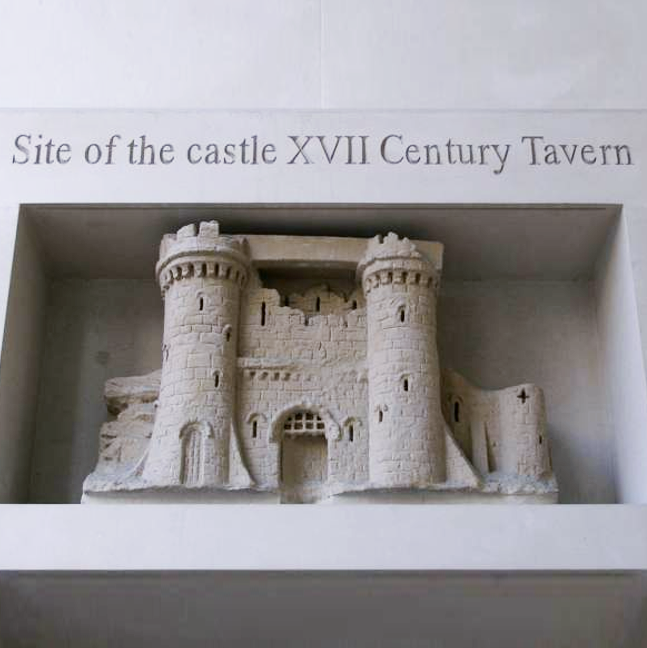
The name lives on, however, in the Cateaton Meeting Room at 85 Gresham Street. And the Castle Tavern has left a more tangible reminder of its existence. Next time you visit St Lawrence Jewry, pause at the western corner of King Street where it meets Gresham Street and look up. Mounted on the wall is a stone sign bearing the name Castle Tavern.
Such signs, carved in stone or wood, were once a familiar sight throughout the City. Many survive in the Museum of London and occasionally emerge for exhibitions. The Castle Tavern sign is particularly evocative: it remains close by its original location, a small but tangible reminder of the London in which our predecessors lived, worked and held their Court meetings.
On 2 October 1809, the Company met in the Edinburgh Tavern, Sweeting’s Alley, Cornhill, where the Court discussed an “unnecessary and improper conspiracy” among Master Pipe Makers to increase prices by 25 per cent. The proposed increase was considered likely to damage the trade of the many licensed victuallers who sold pipes in the City.
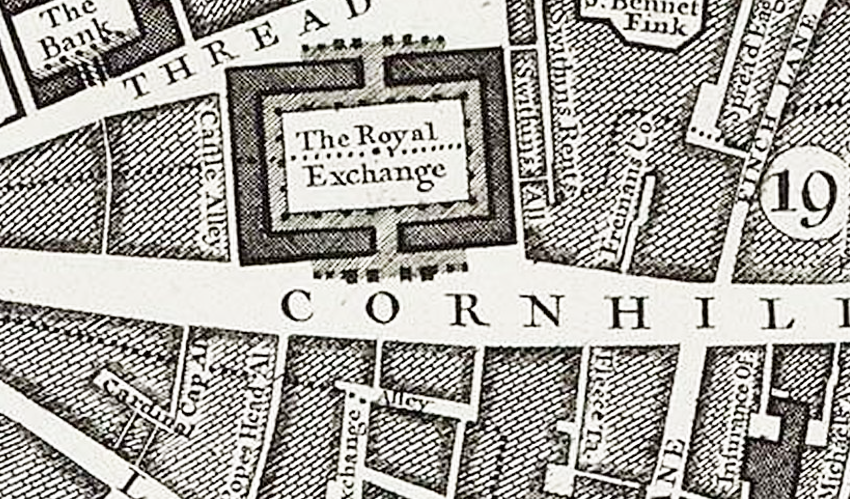
Sweeting’s Alley, also known as Swithin’s Alley or Sweeting’s Rents, ran along the eastern end of the Royal Exchange. An Edinburgh Coffee House is recorded there as early as 1760 and probably this became the Edinburgh Tavern, which was still trading at No. 1 Sweeting’s Rents in 1832. By 1840, however, both the tavern and the alley had disappeared, swept away as part of the redevelopment surrounding the Royal Exchange. The new Royal Exchange Buildings opened in 1844, and the site is now the busy paved area that leads from Exchange Buildings towards Threadneedle Street.
On 19 January 1819, the Company met at the Peacock Tavern, 34 Lower Whitecross Street, Cripplegate, to agree the price of pipes following a rise in the wages of journeymen.
The Peacock had an impressive pedigree. Its brewhouse dated back at least to 1550, while the tavern – the brewery tap – was described by Ned Ward in his famous 1718 guide to London’s drinking establishments as the “House of Humming Stingo”. The tavern subsequently moved to 12 Whitecross Street, but the area was devastated during the Blitz. When the Barbican Estate was built after the war, much of this section of Whitecross Street disappeared beneath the new development. The short surviving section between Silk Street and Chiswell Street/Beech Street was absorbed into Silk Street, leaving only the northern section, including the famous Whitecross Street market.
Today’s Court meetings may take place beneath painted ceilings, surrounded by portraits, silver and other treasures, but it is worth remembering that the business of the Company was once conducted in rather more earthy surroundings – over a pint of ale, perhaps, in one of the City’s many taverns, with the Master Pipe Makers arguing about prices, wages and competition.