
St Giles Cripplegate, a Cross of Nails and an Unexpected Connection
1st September 2026St Giles Cripplegate
1966 was a legendary year. Not only did England win the World Cup and my youngest sister was born, but St Giles Cripplegate, the beautiful church in the Barbican, was finally re-opened for worship after its destruction in the Blitz in 1941. We have a special affinity with St Giles, as it's the church where where our Company’s Chaplain, Father Jack Noble, is the devoted Rector.
Like most City churches, this is another with quite a history. It’s where John Milton was buried, Oliver Cromwell was married and Daniel Defoe worshipped. And there is an important connection with our own Company: Cripplegate was one of the centres of the pipe-making trade in the 17th and 18th centuries, and many pipe makers and their families would have worshipped in this medieval church, which originally stood outside the City walls.
St Giles was hit by a bomb early in WW2, followed by further incendiary attacks. Then, during a terrible air raid in 1941, the Cripplegate district was almost entirely devastated. Most of the church's interior and furnishings were destroyed in the flames, and the heat was so intense that even concrete caught fire.
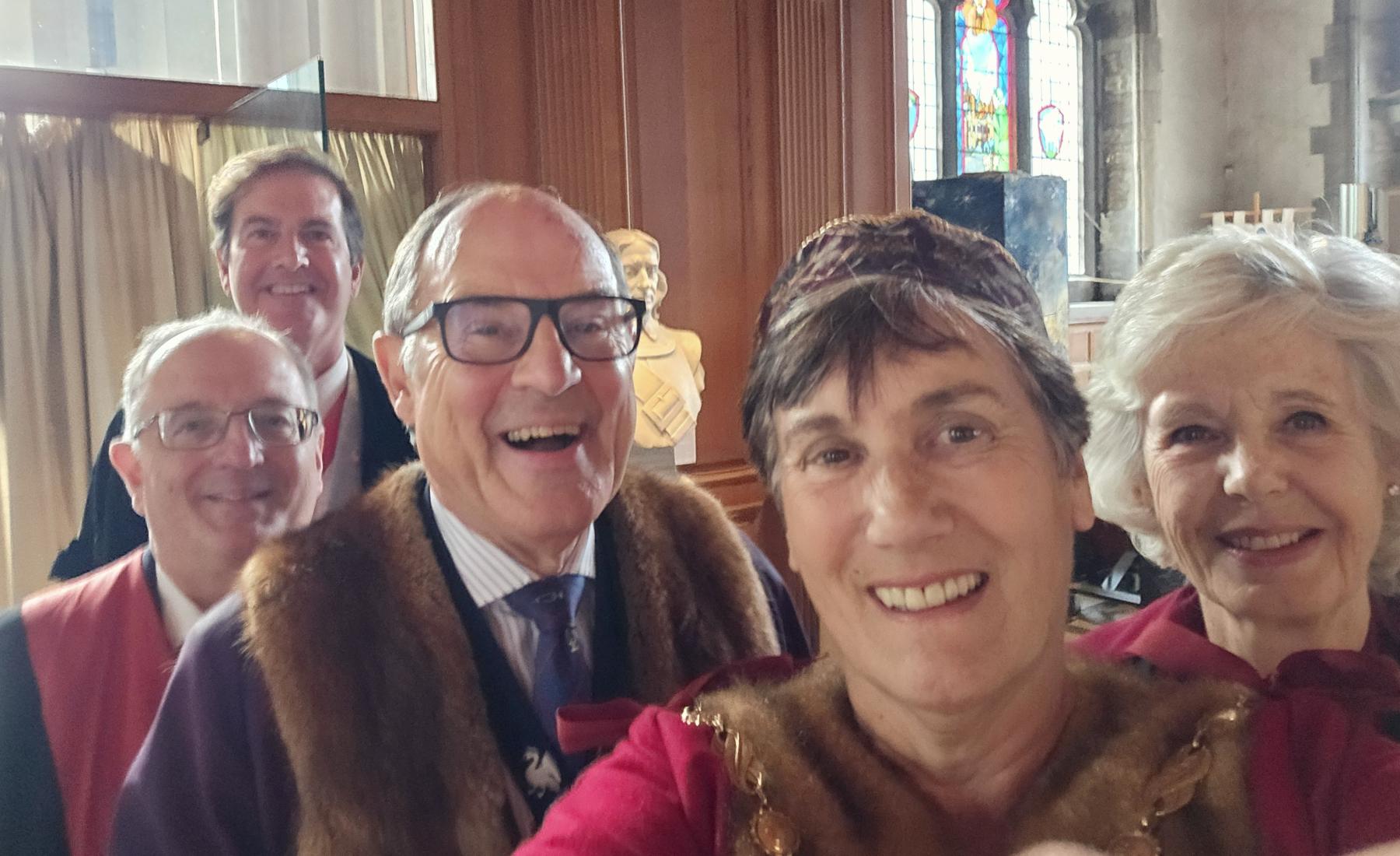
Remarkably, much survived including the exterior walls, the 14th-century chancel arcade and the 1682 west tower. The church was eventually restored between 1954 (the year our Modern Company was founded) and 1966, using the original plans from a 16th century reconstruction. And so, 60 years after its re-opening, four Masters — representing the Musicians, the Barbers, the Architects and our own Company — robed together with the resident and visiting clergy (including Fr Titley, Vicar of St Lawrence Jewry, our own Guild Church) to process down the central aisle for a service of rebuilding, rejoicing and renewal.
It was a beautiful and moving evening with a large congregation. We sang wonderful hymns and responses, listened to prayers from representatives of partner churches in Ontario, Canada, and in Germany, and then witnessed a particularly significant moment: the presentation to St Giles of a Cross of Nails by the Reverend Canon Kate Massey, Canon for Arts and Reconciliation at Coventry Cathedral.
The Cross of Nails has its origins in the destruction of Coventry Cathedral during the Blitz. Following the bombing and the inferno, nails recovered from the Cathedral's ruins were fashioned into crosses as a symbol of reconciliation and hope which were shared with other war-damaged churches. The Community of the Cross of Nails was created and now links some 260 partner organisations around the world.
What I hadn't realised was that I had a very personal connection with that story.
I volunteer as the research historian and archivist for Monkton Combe School in Bath, where our son was a pupil for 14 years. Its Junior School was established in the late 19th century by the Revd and Mrs Howard, in a house just six doors along the road from our own home.
In 1940, the Provost of Coventry Cathedral was R T Howard, who happened to be an Old Monktonian - a son of the Junior School's first Headmaster and brother of the Canon of the Cathedral. In the days following the destruction of the Cathedral, he recovered a handful of ancient nails from the hot ashes. These were fashioned into a small Cross of Nails, which was presented to Monkton Combe Junior School by the Bishop of Coventry in 1957.
For many years it stood on the altar in the School's little chapel, next door to where we live. Then, in 2016, the chapel was sold. The Cross was carefully packed away and, somewhere in a box in the School's archives, it still awaits rediscovery.
Until I sat in the south aisle of St Giles and watched a modern Cross of Nails being presented to the church, I had not fully appreciated the significance of the little cross in Monkton Combe School’s archives — or realised that it was part of this much larger international story of remembrance, reconciliation and peace.
It was one of those extraordinary coincidences which make history suddenly very personal.
We processed out to the stirring sound of both organs before joining the congregation and clergy for a glass of fizz and a few canapés. It was a privilege to be part of such a moving and historic occasion, in a church with such strong connections to the City - and, unexpectedly, to our own Company and to a little school chapel in Bath.
Thank you, Father Jack, and all the team at St Giles, for making us so welcome and for allowing us to share in such a memorable occasion.